
August 13, 2026 by Azur Ali
Boulder house cleaning is harder than most people expect when they move here, and the environment is largely why. Sitting at roughly 5,400 feet in a semi-arid Front Range climate, Boulder combines low humidity, strong seasonal winds, an active outdoor lifestyle, and recurring wildfire smoke in ways that accelerate dust and grit buildup well beyond what national cleaning guides anticipate. This is not a reflection of how you clean. It’s a geography problem. By the end of this article, you’ll understand which specific local conditions drive faster buildup in Boulder homes and how to adjust your cleaning cadence to actually keep up with them.
The Short Answer: Boulder’s Environment Accelerates Dirt Buildup
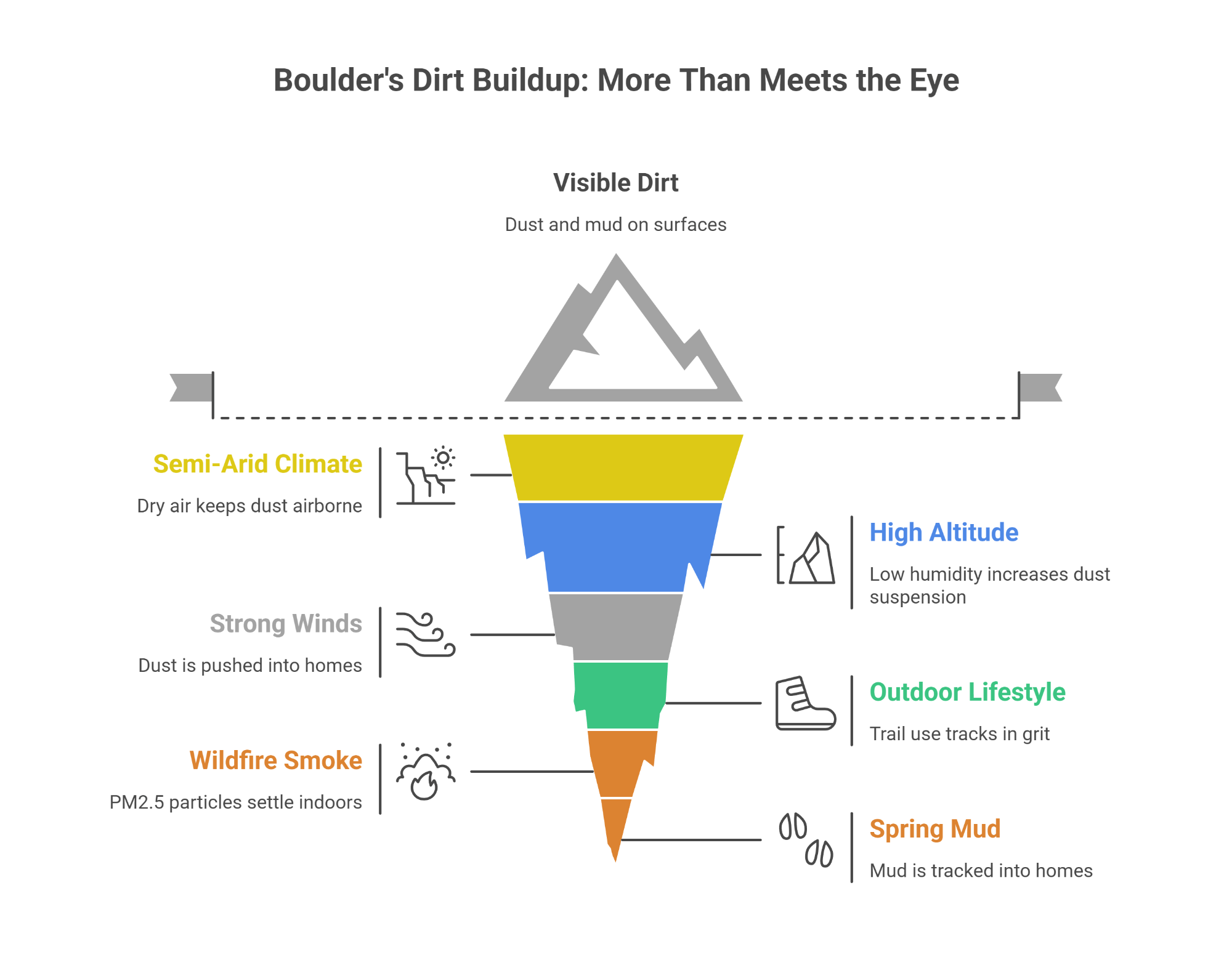
Boulder’s semi-arid climate creates cleaning conditions that are measurably different from the national average. The main contributors are:
- High altitude and dry air: indoor humidity drops to 12-18% in winter, keeping dust airborne longer
- Strong Front Range winds: push fine clay-based dust and particulates into homes through gaps in windows, doors, and baseboards
- Active outdoor lifestyle: trail use tracks in red clay grit, soil, and plant material daily
- Wildfire smoke season: summer through early fall brings PM2.5 particles that settle on interior surfaces
- Spring mud season: March through May turns trailheads and driveways into tracked-in mud corridors
Following a generic monthly cleaning schedule here often means living with more grit than you should.
Low Humidity at 5,400 Feet Changes How Dust Behaves
Most of the country lives at indoor humidity levels between 30 and 50 percent. In Boulder, indoor relative humidity can drop to the 12 to 18 percent range during winter and shoulder seasons. That difference matters more than most people realize when they first arrive here.
In dry air, dust particles stay airborne longer and travel farther before they settle. In a more humid climate, those same particles tend to clump together and fall faster, making them easier to catch in a single pass. Boulder’s dry air keeps them circulating, which means they land on more surfaces, including vertical ones: window blinds, lampshades, door frames, baseboards, the backs and tops of electronics, and open shelving.
This is consistent feedback from customers who’ve relocated from the Midwest, East Coast, and Gulf Coast: they cleaned thoroughly, came back three days later, and found visible dust on surfaces they had just wiped. That is not a cleaning failure. It’s a physics difference specific to this climate. The practical response is more frequent attention to flat surfaces, shelving, and electronics, not harder scrubbing on a monthly schedule. A recurring cleaning cadence addresses this systematically, visit after visit.
Front Range Winds Drive Seasonal Dust Surges
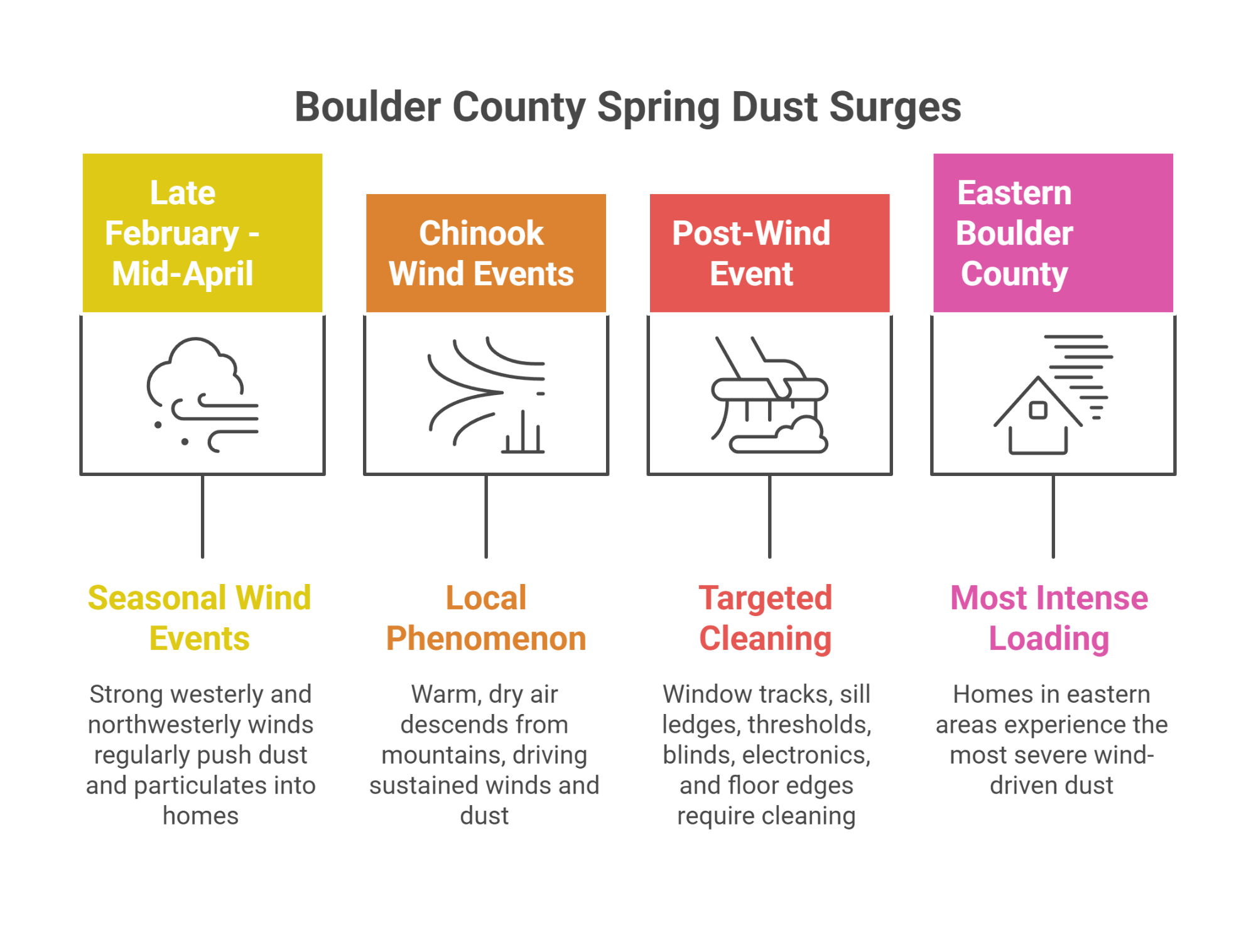
Boulder County sits at the point where the foothills meet the plains, putting it directly in the path of strong westerly and northwesterly wind events. From late February through mid-April, spring gusts regularly push fine clay-based dust from the eastern plains and organic particulates from the foothills into gaps around windows, doors, siding seams, and baseboards. This pattern is documented annually, and anyone who has lived here through a spring season knows exactly what it looks like.
Chinook wind events, which occur when warm, dry air descends rapidly from the mountains, are a named local phenomenon that compounds the problem. These can drive strong sustained winds that push dust into homes even when windows and doors are closed. After a major wind event, the surfaces that need targeted attention are window tracks, sill ledges, entryway thresholds, horizontal blind slats, ceiling fan blades, electronics, and floor edges and baseboards throughout the home.
Homes in the eastern portions of Boulder County tend to see this wind-driven loading most intensely, given their proximity to open plains with less windbreak.
The Trail-to-Home Effect: Boulder’s Outdoor Lifestyle Tracks In More Than You Think
The city of Boulder manages more than 45,000 acres and roughly 155 miles of trails. Residents use them constantly, which is one of the best things about living here. It also means that entryways, rugs, and floors take on a daily load of tracked-in soil, red clay grit from the Flatirons foothills, plant material, and fine dust that generic cleaning advice does not account for.
Homes near trailheads see the most concentrated impact. A family returning from Mt. Sanitas, the Sanitas Valley Trail, the Boulder Creek Path, or Chautauqua brings in a meaningful amount of particulate on shoes and clothing. That material ends up on entryway rugs, mudroom floors, hardwood and tile floor edges along high-traffic corridors, upholstered furniture where gear gets set down, and baseboards along the most traveled routes through the house.
Vacuuming high-traffic corridors between professional cleanings helps, but it doesn’t replace the systematic floor-edge and baseboard cleaning that catches what everyday vacuuming misses.
How Pets Multiply the Trail-Tracking Problem
Dogs that hike carry trail particulates, pollen, and moisture directly into the home on their fur and paws. Pet hair acts as a surface collector, picking up dust and allergens from the air and depositing them on furniture, bedding, and floor corners. A dog that runs the open space trails two or three times a week is essentially redistributing trail soil across every upholstered surface in the house.
In the Boulder homes we serve, pet households near open space trailheads consistently show faster buildup than comparable homes without pets. The compounding effect is real. For these households, a bi-weekly schedule is often the minimum that actually keeps pace with what the home accumulates.
Wildfire Smoke Season Adds a Second Cleaning Layer
Wildfire smoke is a recurring Front Range air-quality event, most common from summer through early fall. The EPA confirms that fine particles from smoke, commonly measured as PM2.5, enter buildings through gaps and HVAC systems and settle on interior surfaces. This is not the same as everyday dust, and it doesn’t respond the same way to standard cleaning techniques.
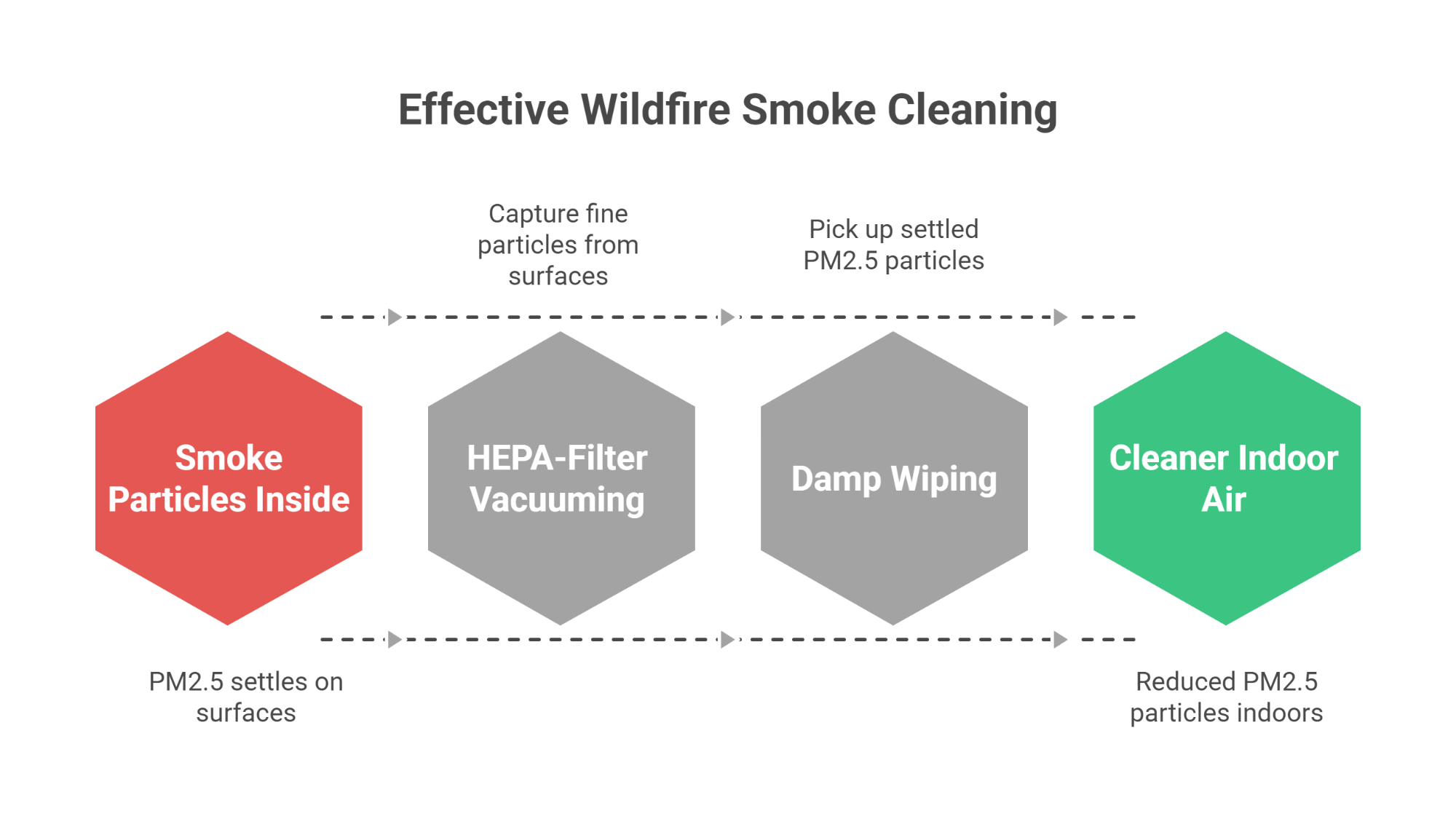
Dry dusting after a smoke event can redistribute PM2.5 particles rather than remove them. A more effective approach after a significant smoke event follows these steps:
- HEPA-filter vacuuming: captures fine particles from floors, upholstery, and fabric surfaces without releasing them back into the air
- Damp wiping of flat surfaces: picks up settled PM2.5 on counters, shelves, blinds, and electronics rather than redistributing it
Homeowners concerned about indoor air quality after smoke events can learn more here on how regular house cleaning can actually reduce allergens. This is a seasonal cleaning consideration specific to Colorado that a locally informed cleaning team plans for.
Mud Season Is Real and It Has a Cleaning Schedule
Boulder’s snowmelt season runs roughly from March through May, and it turns trail access points, neighborhood paths, and driveways into tracked-in mud corridors. Homes with children or dogs see the worst of it. Red clay soil from the Flatirons foothills area is particularly sticky and staining on rugs and hardwood floors.
In the homes we clean between March and May, we consistently see more buildup than at any other time of year on entryway rugs, mudroom floors, hardwood floor edges along high-traffic paths, first-floor baseboards, and tile grout lines in kitchens and bathrooms near entry points.
National cleaning guides and generic service schedules do not address mud season because it is a hyperlocal phenomenon. The practical response is either a temporary increase in cleaning frequency during peak mud season or a targeted deep cleaning service at the end of May to reset entryways, baseboards, and rugs before summer begins.
What This Means for Your Boulder Cleaning Schedule
Most national cleaning guides recommend monthly cleaning. That cadence was developed for average U.S. conditions, not for a semi-arid Front Range city at 5,400 feet with spring dust surges, wildfire smoke seasons, and active trail use. Homeowners who follow a monthly schedule here often find their homes dusty within days of a cleaning. The correct response is adjusting the schedule to match the actual environment.
For more detail on choosing a cleaning frequency in Boulder based on your household type, the linked guide above walks through the decisions in detail. The table below gives a practical starting point:
| Household Type | Key Exposure Factors | Recommended Cadence |
|---|---|---|
| Couple, no pets, minimal outdoor activity | Baseline Boulder dust and wind | Bi-weekly |
| Family with children, active schedule | Trail tracking, mud season, higher surface area | Bi-weekly |
| Family with dogs, near trailhead | Pet hair, trail particulates, pollen, mud season | Weekly or bi-weekly |
| Older home with less tight construction | Wind infiltration, drafts, HVAC distribution | Bi-weekly |
| Short-term rental or Airbnb property | High turnover, guest tracking, trail proximity | Per-turnover cleaning |
Vacation rental hosts and Airbnb operators in Boulder have their own set of considerations. Our vacation rental cleaning service is built around the fast turnarounds that property managers and rental owners need, including photo documentation after each clean.
How 303 Crown Maids Cleans for Boulder’s Specific Conditions
303 Crown Maids is a locally owned cleaning company founded in Boulder County, designed for homes in this environment rather than adapted from a national template.
Every visit follows the same 75-point cleaning checklist, which covers the exact surfaces where Boulder’s conditions create accelerated buildup: window tracks and sill ledges, ceiling fans, overhead light fixtures, and floor edges throughout every room.
These are the areas a casual clean often skips and where Front Range dust visibly accumulates between visits. Systematic coverage on a recurring schedule means the buildup never reaches the point where a full reset is needed.
Each cleaning job is staffed by an experienced cleaning team with a minimum of three years of professional experience and a thorough background check. Learn more about the benefits of recurring cleaning in Boulder County, including practical use cases in full. To review service options, visit our recurring standard cleaning service page for a full overview of what is included on every visit.
What a Boulder-Specific Cleaning Visit Actually Covers
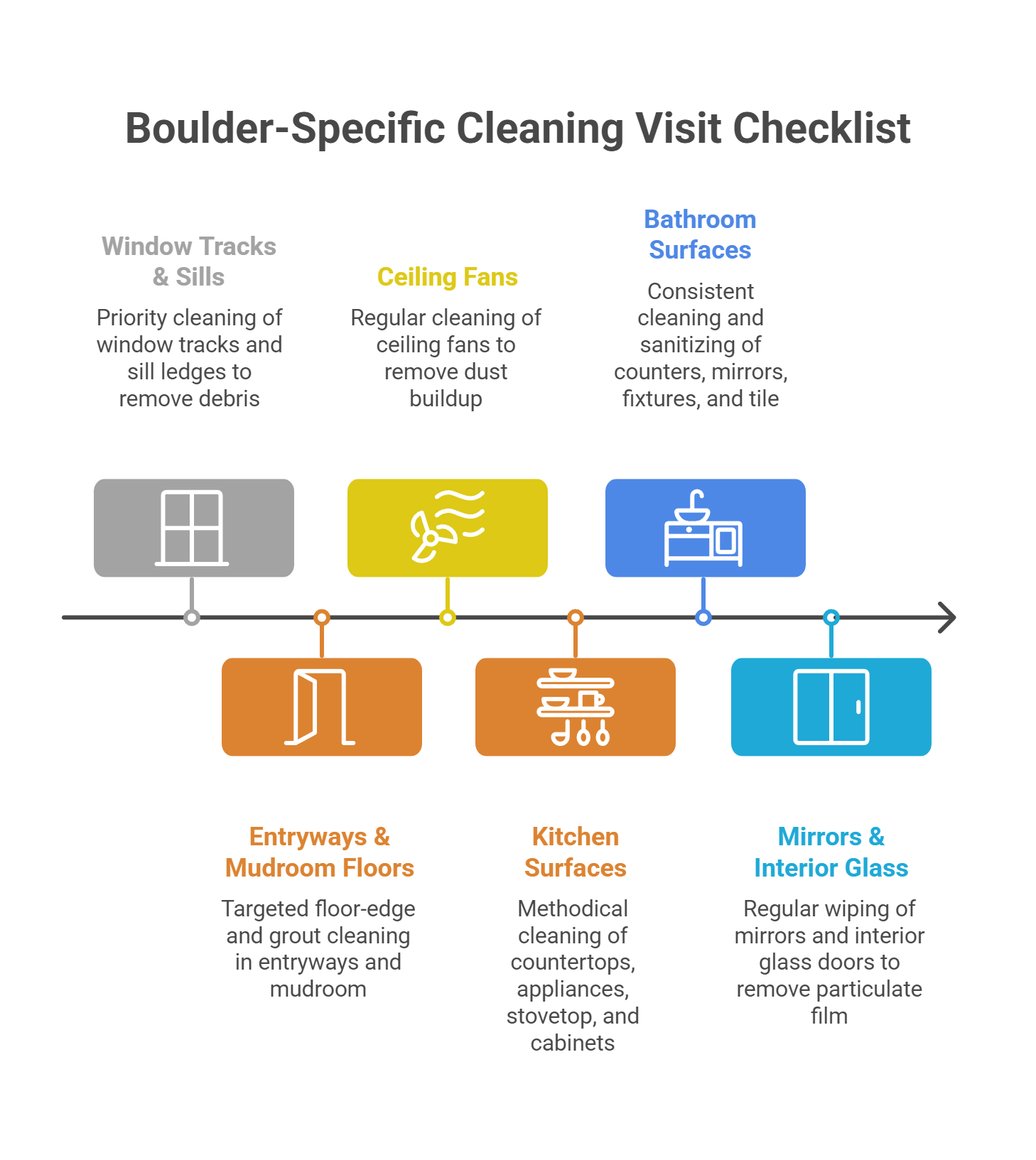
Generic cleaning services follow a standard room-by-room checklist that was not built around Front Range conditions. A recurring, standard cleaning visit designed for Boulder homes looks different in a few specific ways, including, but not limited to:
Window tracks and sill ledges
- Are treated as priority surfaces. After a spring wind event, these collect more debris than almost any other surface in the home. Clearing them on every visit removes particulates before it gets redistributed through the house by foot traffic or airflow.
Ceiling fans
- Are included on every standard visit. Fans run longer in Boulder’s dry climate because residents use them as a substitute for air conditioning during shoulder seasons. That extended run time means faster blade buildup, and a dusty fan redistributes particulates every time it runs.
Entryways and mudroom floors
- Receive targeted floor-edge and grout cleaning, particularly during mud season. These surfaces take the first impact of tracked-in trail soil and are the most direct route for outdoor particulates to migrate into the rest of the home.
Kitchen surfaces
- Get methodical attention on every visit. Countertops, the exterior of appliances, stovetop surfaces, and cabinet fronts all collect a fine layer of airborne particulate that settles faster in Boulder’s dry air than in more humid climates. Wiping these down on a consistent schedule prevents that layer from bonding to surfaces and becoming harder to remove over time.
Bathroom surfaces
- Including counters, mirrors, fixtures, and tile, are cleaned and sanitized on every standard visit. Boulder’s low humidity produces less soap scum buildup than coastal climates, but fine dust still settles on bathroom surfaces and around fixtures. Consistent attention keeps these surfaces clean without the need for heavy chemical treatments.
Mirrors and interior glass doors
- Are wiped on every visit. After a spring wind event or a period of high wildfire smoke, these interior surfaces collect a visible film of fine particulate. Clearing these on a regular cadence improves both air quality and natural light inside the home.
Frequently Asked Questions About Boulder Home Cleaning
Why is my house so dusty in Boulder, CO?
Boulder’s dry air keeps indoor humidity in the 12 to 18 percent range in winter, which allows dust to stay airborne longer and settle on more surfaces. Strong spring winds push clay-based dust into homes through gaps around windows and baseboards. Add pets or regular trail use and buildup accelerates further. It is a geography problem, not a cleaning failure.
How often should I clean my house in Colorado?
Most Boulder households need bi-weekly cleaning as a baseline. Homes with pets, children, or trailhead proximity often need weekly service during mud season and spring wind season. A monthly schedule leaves most Boulder homes visibly dusty between visits.
Does wildfire smoke affect how I should clean my home?
Yes. Dry dusting after a smoke event redistributes PM2.5 particles rather than removing them. HEPA-filter vacuuming and damp wiping of flat surfaces are more effective. A locally informed cleaning team plans for this as a seasonal Front Range consideration.
Is a recurring cleaning service worth it in Boulder?
For most Boulder households, yes. Consistent maintenance prevents buildup from reaching the point where a full reset is needed, keeping every visit faster and more thorough. The benefits of recurring cleaning go beyond cleanliness, giving back time that most dual-income Boulder households do not have.
What should I do if I just moved to Boulder and my home is already dusty?
Our Boulder move-in cleaning service is the practical starting point. It gets the home to a true baseline before you establish a recurring schedule, and gives you an accurate read on what your specific home accumulates between visits.

The Next Step for Boulder Homeowners
Boulder’s altitude, dry air, Front Range winds, active outdoor lifestyle, wildfire smoke season, and mud season create cleaning conditions that genuinely differ from the national average. A generic monthly schedule often means living with more dust and grit than you should between visits. The practical response is a recurring cleaning cadence matched to your household’s actual exposure.
303 Crown Maids offers instant online pricing, booking in about 60 seconds, no contracts, and a 100% satisfaction guarantee. Experienced cleaning teams follow the same 75-point checklist on every visit. Get an instant quote and book your first clean at 303crownmaids.com/book. No phone call required. No in-home estimate. We serve the cities of Boulder, Longmont, Fort Collins, Lafayette, Louisville, Erie, Evergreen, Broomfield, Superior, Gunbarrel, Brighton, Denver, Loveland, Greeley, Windsor, and surrounding Front Range communities.
If you want to review service options before booking, see our Boulder standard cleaning service page for a full overview of what is included on every visit.

Written by Azur Ali
Azur Ali is the founder of 303 Crown Maids, a locally owned cleaning company serving Boulder and the surrounding Front Range. The company handles recurring home cleanings, move-in and move-out cleans, short-term rental turnovers, and commercial work across Boulder County. Azur grew up in Boulder and built the company to fix a process he found broken on both sides, for the people booking a cleaning and for the people doing the work.



Stay Updated
We will send you info about our business